
LAYERED LANDS
Transition to US Rule
In 1848 the Mexican American War ended, gold was discovered at Sutter’s Mill, and California was fast-tracked to statehood in 1850. As the 19th century came to a close, the region's legal system as well as its social and cultural landscape were transformed. After congress established the California Land Commission in 1851 to prove the validity of Spanish and Mexican land grants, land-wealth shifted from Mexicans to Anglo-Americans through legal, if ethically dubious, means, and californios were edged out of political power. As the 20th century dawned, the californios were systematically rewritten into a new story of California, a romantic fantasy of caballeros, señoritas, kindly priests, and docile Indians that served the needs of the now dominant Anglo-American majority but bore little resemblance to the actual history of the region.
The situation worsened in 1824 when Mexico's new constitution kept California as a protected territory, not a state. This decision upset the elite Mexican Californians, called californios, and opened the door for British, French, and US settlers to establish themselves economically and politically. California became a frontier with tension and change brewing, shaping its future dramatically.
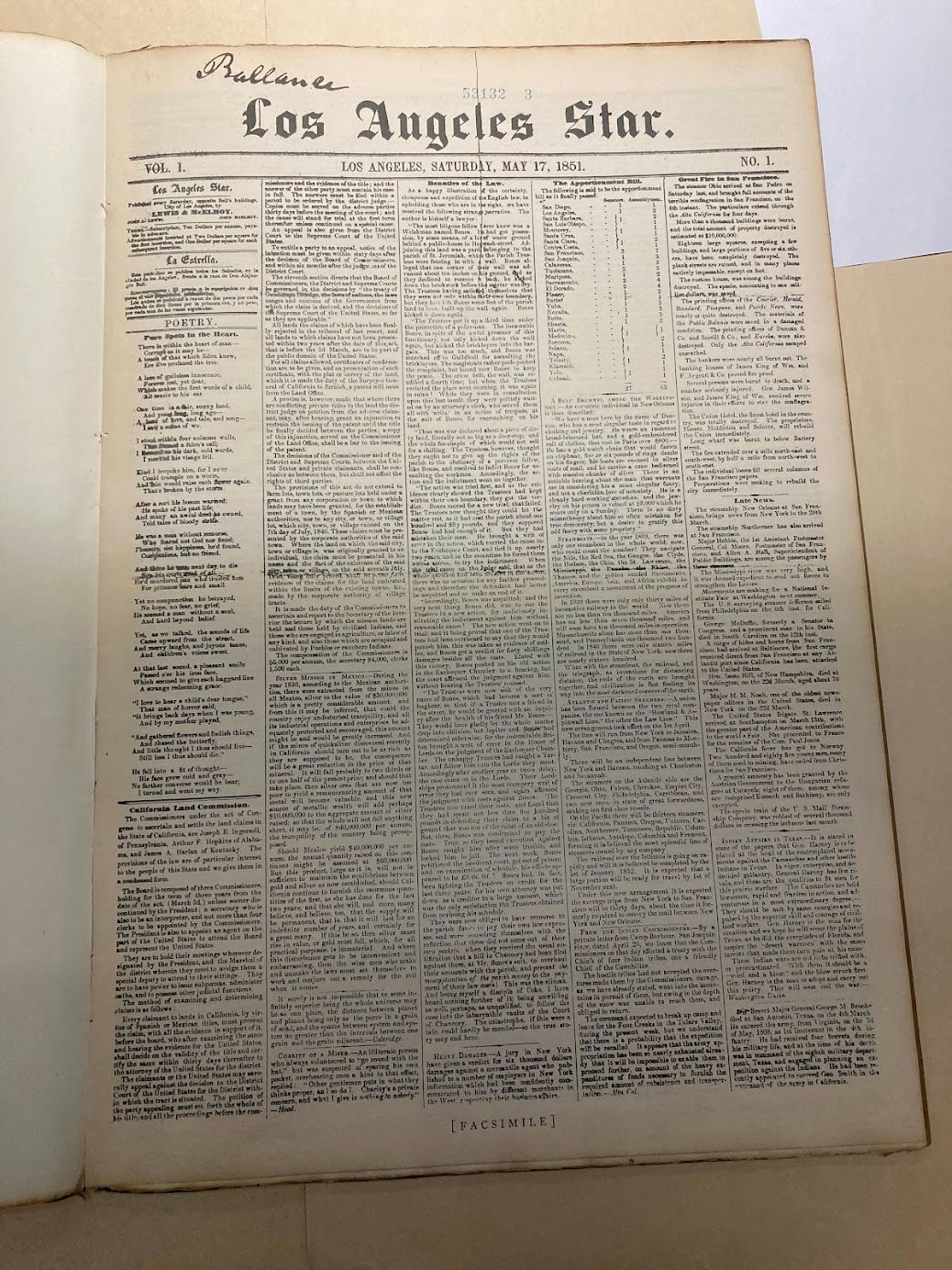
The Star. Theodore Foster, May, 1851 photographer, ca 1882
(Los Angeles Public Library)
The Star, Los Angeles’ first paper of record, ran from 1851-1879, and from the start it included a Spanish-Language section, "La Estrella." One of its first editors, Francisco Ramírez, was hired in 1851 as a compositor when he was only 14, rising quickly to become editor of "La Estrella" in 1854 and then leaving in 1855 to found his own, Spanish-language newspaper, El Clamor Público.
.jpg)
El Clamór Público. Francisco Ramírez, [date of issue displayed]
(Los Angeles Public Library)
El Clamór Público was the third newspaper to appear in Los Angeles, after The Star in 1851 and the Southern Californian in 1854, and it was the first fully Spanish-language publication. Francisco Ramírez, former editor of "La Estrella," the Spanish-language section of The Star, launched El Clamór in 1855 when he was just 19 years old. He called it a "Periodico Independiente y Literario," publishing poetry and literature alongside forceful critiques of US American empire and the poor treatment of Mexican Americans.
.jpg)
Reminiscences of a ranger, or, Early times in Southern California. Horace Bell, 1881
(Los Angeles Public Library)
This is a first edition of Bell’s wildly entertaining account of Los Angeles during the early-US period. It is thrilling and required reading for anyone interested in the nineteenth-century US. Bell speaks admiringly of the californio society he encounters in Los Angeles, including José Antonio Carrillo, ancestor of actor and conservationist Leo Carrillo. When the writer came to Los Angeles … society was really good; better, the writer ventures the assertion, than at present or than may reasonably be expected within the next decade. Prior to and at that time the old wealthy and intelligent Spanish families had formed a strictly exclusive class. They went to to make up the aristocracy of this country and dispensed a liberal hospitality that did honor to them as a people, as well as to the more favorite class of Americans who were so fortunate as to gain admission to their circles. Many of them, especially the well-fixed rancheros, dispensed a baronial hospitality, and they could well afford it. Soon after my arrival in Los Angeles it was my good fortune to attend a first-class ball at the house of Don José Antonio Carrillo a first-class citizen, one who had been honored with a seat in the sovereign Congress of Mexico. He had also been the military head of the country, and was at the head of native California ton. The ball was the first of the season. It was attended by the elite of the country from San Diego to Monterey. The dancing hall was large, with the floor as polished as a bowling saloon. The music was excellent – one splendid performer on an immense harp. The assembled company was not only elegant – it was surprisingly brilliant. The dresses of both ladies and gentlemen could not be surpassed in expensive elegance. The fashions of the gringo world had made little innovation on the gorgeous and expensive attire of the country, as to the gentleman, while the ladies were resplendent in all the expensive fashion that could be supplied by unlimited resources. (88-89)
The Political Tide Turns
In 1872, Los Angeles experienced one of its most consequential mayoral contests. The city had been transformed in the years leading up to the election by the establishment of ward boundaries, the racial violence of 1871’s Chinese Massacre, the approval of the Southern Pacific Railroad’s bid to build its southern terminus in the city, and ongoing tensions over water rights. During the campaign, mayoral politics took a racial turn as opponents of the incumbent, Cristobál Aguilar, characterized him as outdated and lacking the necessary vigor and business acumen to navigate Los Angeles into a new era marked by corporate growth. James Toberman emerged as a contender, advocating for a pro-growth agenda and emphasizing Aguilar's perceived lack of English fluency.
Toberman's victory marked a pivotal moment, signaling the end of a period characterized by shared political power and the initiation of a racial hierarchy that marginalized Mexican Americans from the city's political and historical narrative. Notably, Los Angeles would not elect another Hispanic mayor until Antonio Villaraigosa assumed office in 2005. The 1872 election underscores the enduring impact of race and language proficiency in shaping political outcomes and community representation.
.jpg)
Portrait of Cristobal Aguilar. unknown photographer, ca. 1860's
(Los Angeles Public Library, Security Pacific National Bank Collection)
Cristobal Aguilar served as Mayor of Los Angeles from 1866-1868 and 1871-1872. After retiring from a life of politics, he wrote for La Crónica, a leading Spanish-language newspaper.
.jpg)
James R. Toberman, a portrait. unknown photographer, ca. 1870's
(Los Angeles Public Library, Security Pacific National Bank Collection)
James R. Toberman served as Mayor of Los Angeles from 1872-1874 and 1878-1882. Before that he had been a City Council member, a U.S. Revenue Assessor, and a member of the Chamber of Commerce.
What was in Westwood before UCLA?
Nearly all of Los Angeles County was once somebody's rancho. This includes UCLA, which sits on what used to be Rancho San José de Buenos Ayres, a land grant of nearly seven square miles in what’s now Westwood, Holmby Hills, and Bel Air. The story of San José de Buenos Ayres' evolution from farmland to world class university is full of twists and turns. As much as the story is about colonialism and greed, it's also - surprisingly - about how hard it is to build public transportation in Los Angeles. Sound familiar?
José Máximo Alanis acquired the land around 1820. The official grant was given in 1843 by Governor Manuel Micheltorena. Alanis ranched for a while before his death in 1851, after which his children sold half of the rancho to Benjamin Wilson, the second mayor of Los Angeles, in 1852, then the rest of it in 1858. All together, the land sold for just under $17,000 ($700,000 today). What would that kind of money buy in Bel Air in 2024?
Benjamin Wilson sold his share of Buenos Ayres to John Wolfskill in 1884. Wolfskill, a man with a plan, was also on the board of the Los Angeles County Railroad, which in 1887 secured rights from the Santa Monica Land and Water Company to build a light rail line from Burbank to Santa Monica. By 1888 the Railroad had secured deeds from property owners along the route, including Wolfskill, to build the line, but they were never able to complete the work.
In 1891, Wolfskill successfully sued the railroad to return his land, but light rail went in another direction. By 1901 the Los Angeles Country Railroad had been absorbed into the Pacific Electric Railway, which became, by the 1920's, the largest interurban electric railway in the United States, with no lines running through Wolfskill's land
His heirs sold the land to Arthur Letts, founder of the Broadway Department Store chain, who started developing it in 1919. After his death in 1923, Letts’ son-in-law Harold Janss along with his brother, owners of the Janss Investment Company, took control of the land. They sold some to the University of California – which is why UCLA’s landmark Janss Steps are named after them – and went on to develop Westwood Village and its environs. Imagine what Wolfskill and Marcos Alanis would think of the new Westwood/UCLA Metro station set to open in 2027!
Hubert Bancroft
Seven-eighths of all the claimants before the commission were virtually robbed by the government . . . As a rule, they lost nearly all their possessions in the struggle before successive tribunals . . . The lawyers took immense fees in land and cattle, often for slight services or none at all . . . The estates passed for the most part into the hands of speculators who were shrewd enough and rich enough to keep them” (VI. 576).
Hubert Bancroft, History of California (1884)
Bancroft's writing is in the public domain and available for download here https://hdl.handle.net/2027/yale.39002087600350]
.jpg)
Map of the subdivision of Rancho San José de Buenos Ayres and the town of Sunset. Theo. G. Kocher & Co, 1884
(Los Angeles Public Library, Map Collection)
The Los Angeles and Santa Monica Land and Water Company had this map made when The Los Angeles Railroad Company was poised to build a light rail line from Burbank all the way to the beach directly through what used to be Rancho San José de Buenos Ayres. Can you find the track lines?
.jpg)
Diseño of Buenos Ayres. possibly Abel Stearns, 1852
(Bound Manuscripts Collection, UCLA Library Special Collections, Charles E. Young Research Library)
How does this map of San José de Buenos Ayres compare to the other on display here? Typical of the diseños produced during the Spanish and Mexican periods, this hand drawn map lacks mathematical coordinates but marks boundaries with natural landmarks. It shows a house, a canal, two adjacent ranchos, as well as trees, plants, and geological features. This diseño appears to have been drawn by Abel Stearns who owned much land in Los Angeles and Orange Counties. He was also friends with Benjamin Wilson, who bought this land in 1858. We cannot know for sure, but why do you think Stearns might have drawn this map?
.jpg)
Portrait of Marcos Alanis. unknown photographer, 1862
(Los Angeles Public Library, William Mason Collection, El Pueblo Monument Photo Collection)
Marcos Alanis was the son of José Maximo Alanis, first owner of San José de Buenos Ayres.
.jpg)
Mr. & Mrs. Benjamin Davis Wilson. unknown photographer, ca 1875
(Los Angeles Public Library, Security Pacific National Bank Collection)
Benjamin Davis Wilson (1811-1878) came to California from Tennessee in 1841, married Ramona Yorba, of the prominent Yorba family, and acquired a vast property, including San Buenos Ayres. He was elected mayor of Los Angeles in 1851 and was named sub-agent for Indian Affairs for Southern California not long after. Here pictured with his second wife, Margaret Hereford, along with his stepson (left) and nephew (right). Hide 1 hidden field
The Mission Play
One of Los Angeles' First Tourist Attractions
“The Mission Play” was a three-hour historical pageant first staged in 1912. It celebrated California's Spanish missions, portraying a romantic version of the state's history and the interactions between Native Americans, Spanish missionaries, and European settlers. It became a huge tourist attraction – as the postcards on display here attest – and in 1927 production shifted to the San Gabriel Mission Playhouse, which had been built expressly for it. The play closed in 1932, having been seen by over 2.5 million people across 3,198 performances. While initially acclaimed, the play has encountered enduring criticism for historical inaccuracies and cultural biases as time has passed.
This item is in the public domain and available for download here https://www.indigenoushistoriesandcultures.amdigital.co.uk/documents/detail/7082225
.jpg)
The Mission Play. John Steven McGroarty, 1924
(Portraits of early California residents, UCLA Library Special Collections, Charles E. Young Research Library)
(Los Angeles Public Library)
LAPL Rare Books has a beautiful Mission Play program; it’s not digitized but I’d like to digitize it and display the front cover