
LAYERED LANDS
Spain's Colonial Imprint
Spain's legacy in California is deep, vast, and controversial. In the 16th century, Spanish explorers wrote accounts of the land and people they encountered along the coast that were invaluable to Spain's colonial efforts. By the 18th century, these informed expeditions – like the one led by Gaspar de Portolá in 1769 – led to the establishment of missions and initiated Spanish settlement of the region.
Franciscan friars played a pivotal role in this process, subjecting indigenous communities to violent cultural suppression and exploitation. Spain and the Catholic Church are key to California's historical identity, woven into the state's cultural, architectural, and agricultural landscape, interpreted – and misinterpreted – by generations of Californians.
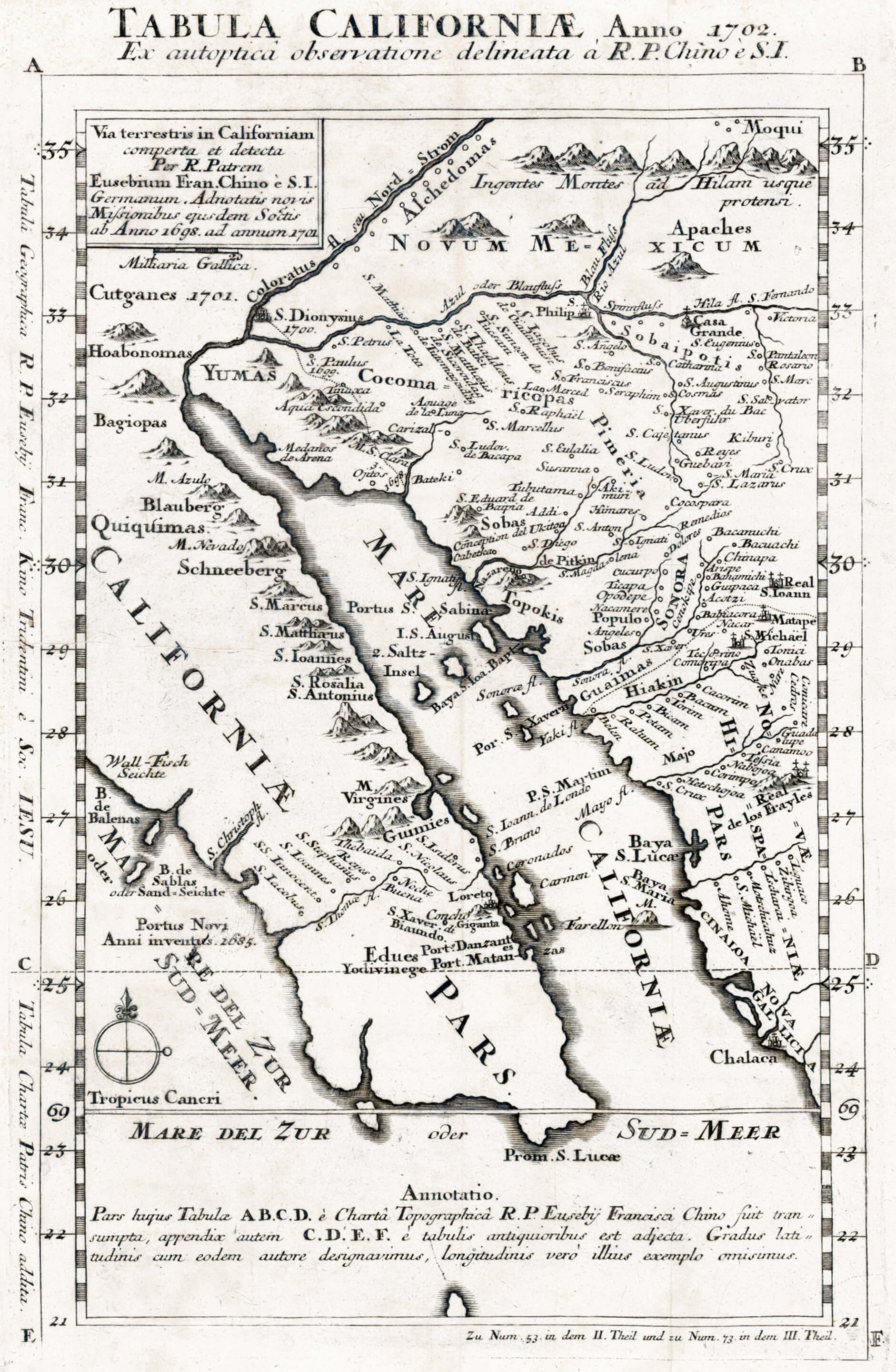
Tabula Californiae, anno 1702
Eusebio Francisco Kino 1701 (Los Angeles Public Library)
Kino's map shows California as connected to North America, ending the widely held notion that it was an island. Kino, a Jesuit missionary, arrived in Baja in 1681 believing in the island myth, but extensive horseback journeys and careful scientific measurements led him to conclude that the island was actually a peninsula. He published the map you see here, which was quickly translated and disseminated widely across Europe. Even so, the myth of California as an island persisted well into the 18th century.
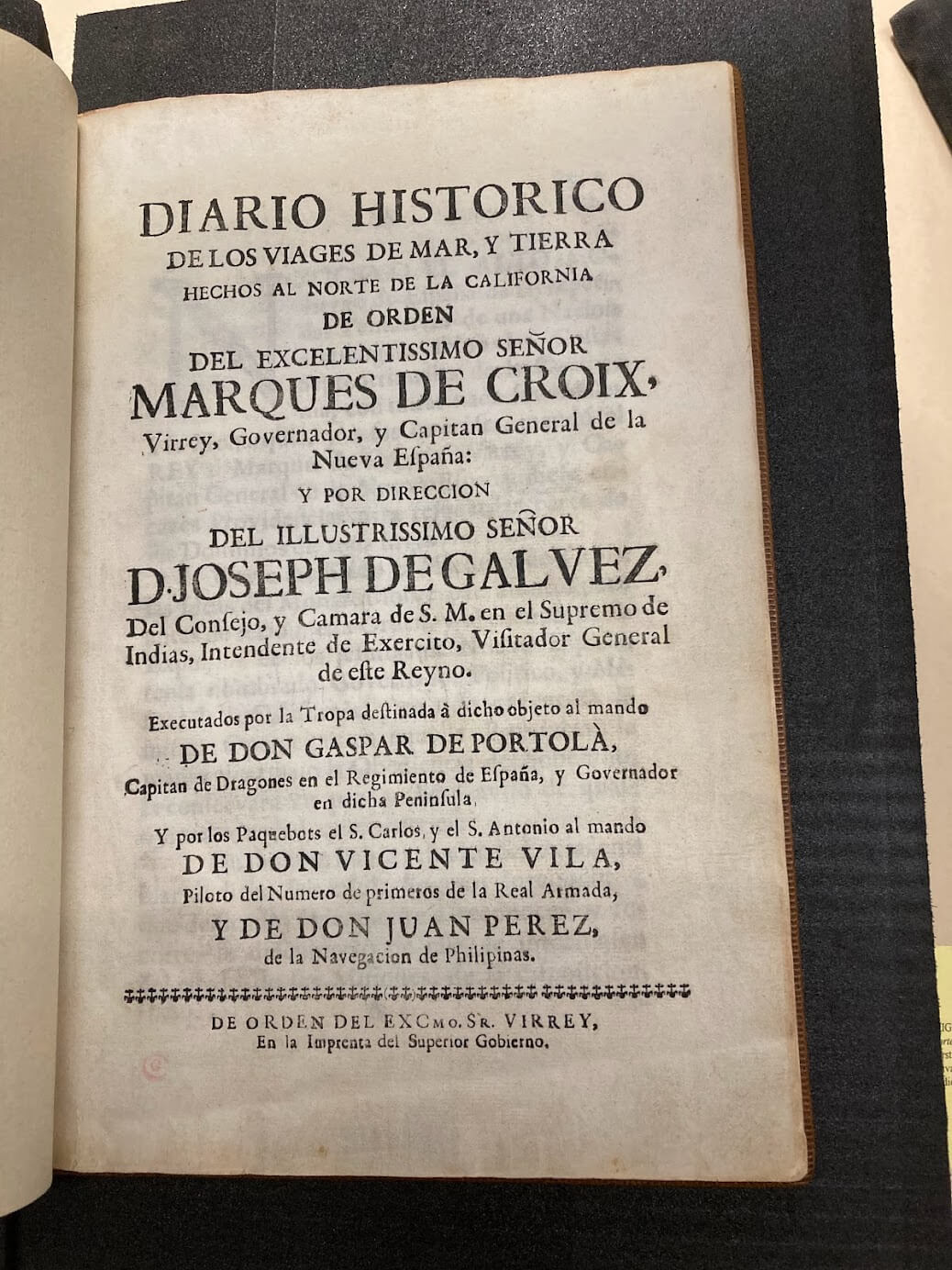
Diario histórico de los viages de mar y tierra, hechos al norte de la California. Miguel Costansó, 1770
E.O.C. Ord and William Hutton A bilingual Digital edition is available in the public domain at https://hdl.handle.net/2027/uc1.31822043017045 (Los Angeles Public Library)
Miguel Costansó's name doesn't appear on the title page of this book, but it is his diary of Gaspar de Portolá's 1769 expedition to explore the California coast and settle Monterey. On this trip Father Junipero Serra founded the mission of San Diego de Alcalá, while Portolá went on by land to Monterey with a small group including Costansó, the expedition's engineer and cartographer. Costansó kept careful records of all they encountered, including the language spoken by the indigenous people they met. After he and Potolá returned to Mexico City, Constansó's diary was printed in limited numbers for private distribution since its publication had not been approved by the Council of the Indies.
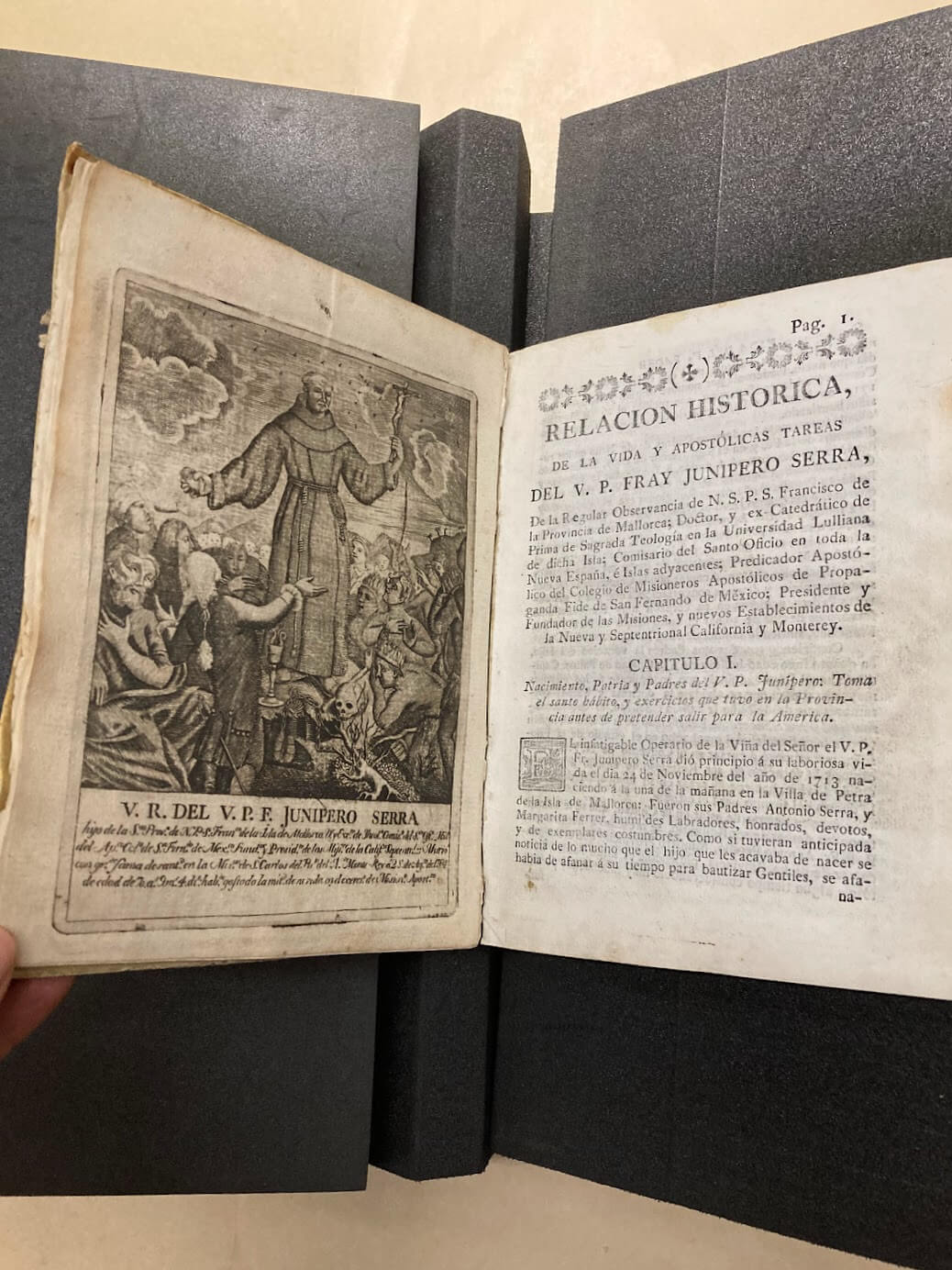
Relacion Historica de la Vida y Apostolicas Tareas del Venerable Padre Fray Junipero Serra, y de las Misiones que fundó en la California Septentrional, y nuevos establecimientos de Monterey.. Francisco Palou, 1787
A bilingual, digital edition is available in the public domain at https://hdl.handle.net/2027/nyp.33433082389465 1832 (Los Angeles Public Library)
Palou's biography of his mentor, Junipero Serra, consists mainly of letters Serra wrote him concerning the California missions, details about the indigenous people he encountered, and descriptions of the landscape. Serra, who founded the mission chain of Alta California (the territory north of the current US-Mexico border), is a controversial but historically significant figure. The engraving of him included in Palou's book, a first edition of which you see here, tells us how Palou felt about Serra, but what do you think? Serra is positioned above the other people in the image, but what is above Serra? What is the artist trying to tell viewers by placing those things above Serra? How do the other people feel about Serra? How can you tell? Why do you think there is a skull in the foreground of this image?
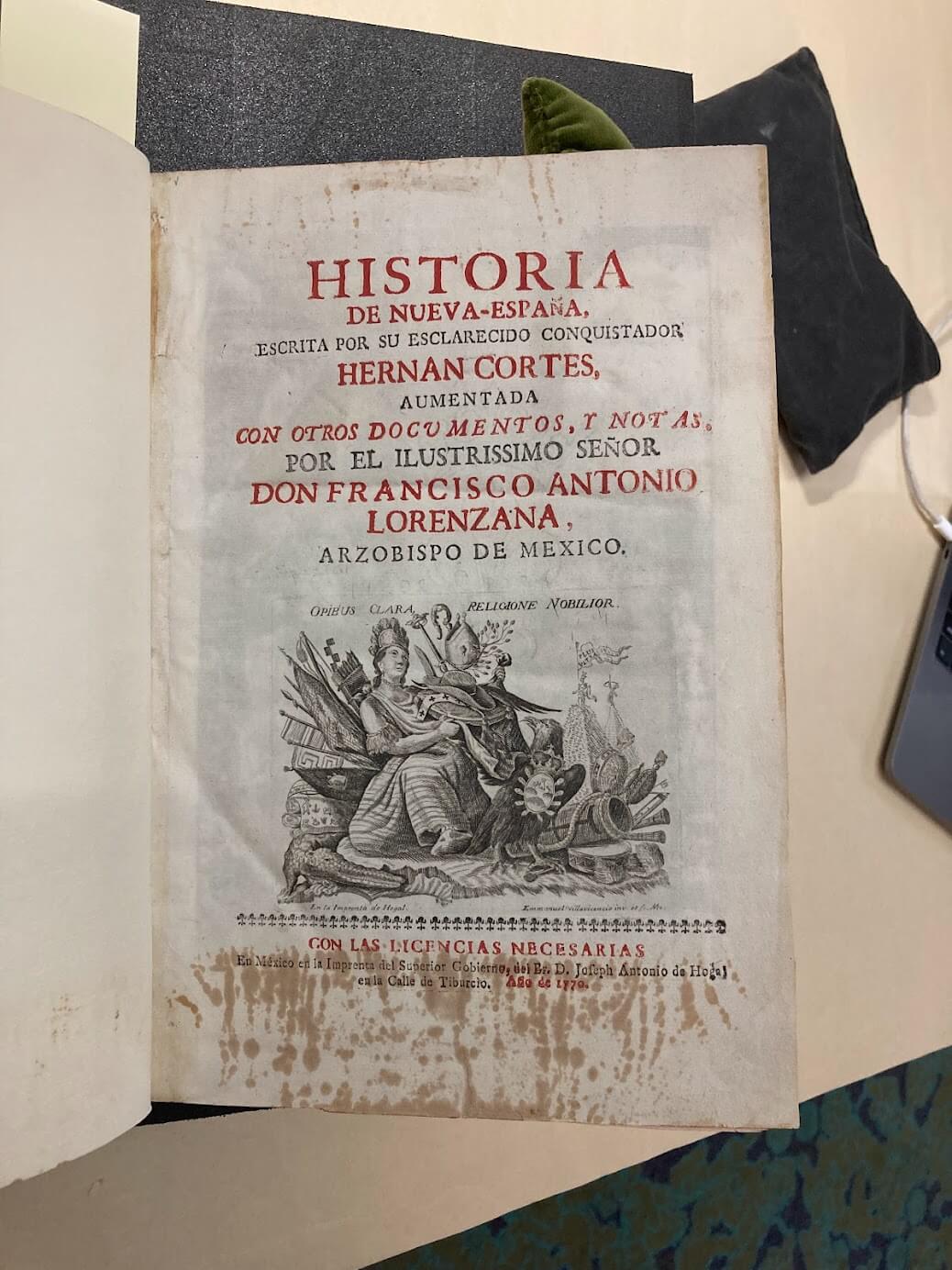
Historia de Nueva España Escrita por su Esclarecido Conquistador Hernan Cortes, Aumentada Con Otros Documentos, y Notas. Francisco Antonio Lorenzana, 1770
A bilingual, digital edition is available in the public domain at https://hdl.handle.net/2027/ucm.5320211143 (Los Angeles Public Library)
Lorenzana, Archbishop of New Spain, compiled this volume to gather information on the history of the colony. Included are an essay on the Viceroys to date, a reprinting of Cortés' famous second, third, and fourth letters to Emperor Charles V, written between 1520 and 1523, and a section of plates copied from a Mexican hieroglyphic book showing articles of tribute paid to Moctezuma.
Reminisces of Pablo Tac
In the mission of San Luis Rey de Francia, the Fernandino father is like a king. He has his pages, alcaldes, majordomos, musicians, soldiers, gardens, ranchos, livestock, horses by the thousand, cows, bulls by the thousand, oxen, mules, asses, 12,000 lambs, 200 goats, etc. The pages are for him and for the Spanish and Mexican, English, and Anglo-American travelers.
The Fernandino father drinks a little, and as almost all the gardens produce wine […] sells it to the English or Anglo Americans, not for money but for clothing for the neophytes, linen for the church, hats, muskets, plates, coffee, tea, sugar, and other things. The products of the mission are better, tallow, hides, chamois leather, bear skins, wine, white wine, brandy, oil, maize, wheat, beans, and also bullhorns, which the English take by the thousand to Boston.
From The Reminisces of Pablo Tac (Luiseño), written in Rome in the 1830s
Teaching resources about Pablo Tac from the National Museum of the American Indian can be found here: https://americanindian.si.edu/nk360/california-missions-4/source-e/]
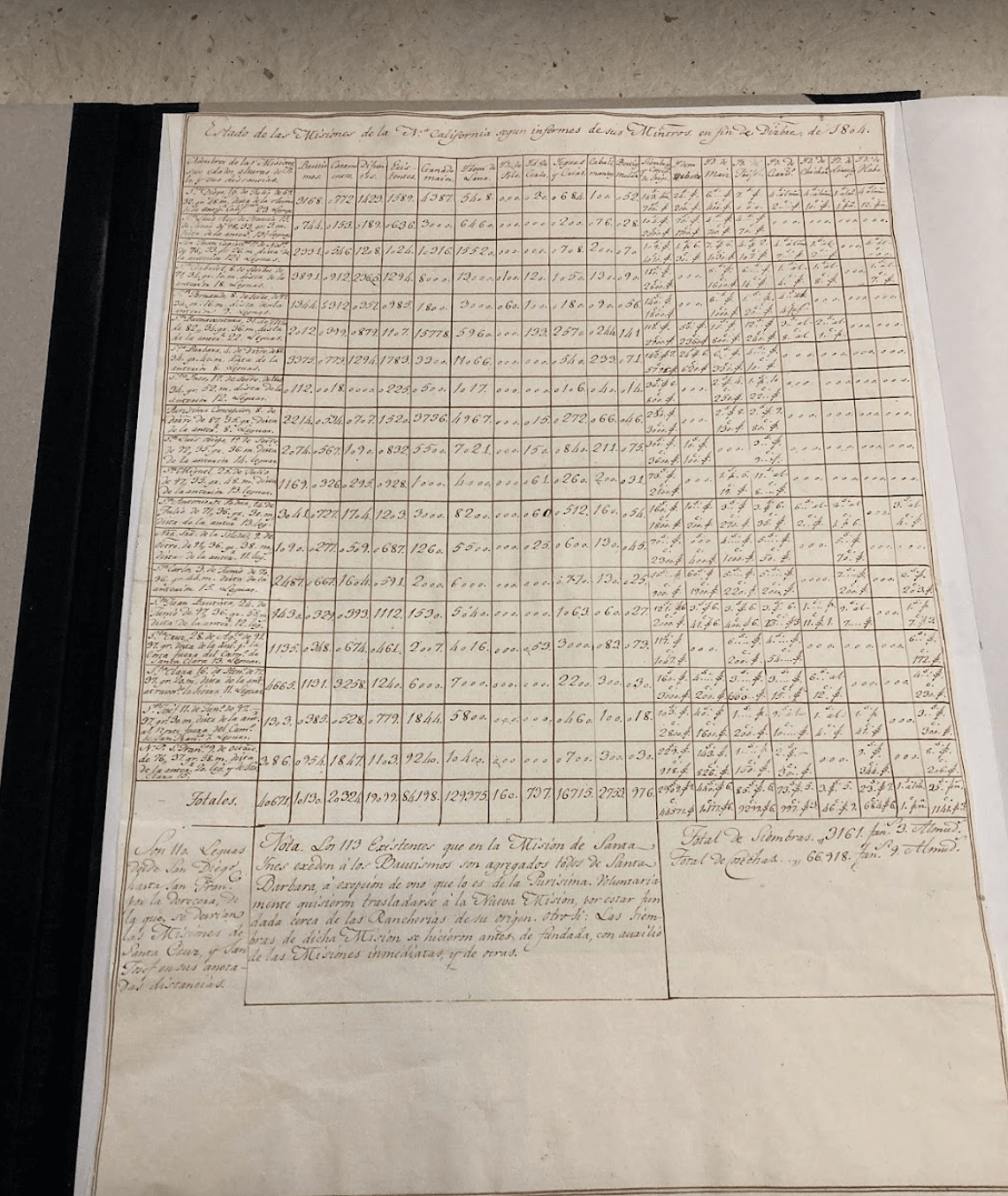
Estado de las Misiones
1804 (Los Angeles Public Library)
This chart indexes the production of food, drink, and animal products at several California missions. (Need type treatment for questions in captions) Who do you imagine worked to make all this stuff? Why do you think the Spanish kept as meticulous records of manufacture as they did of religious conversions?
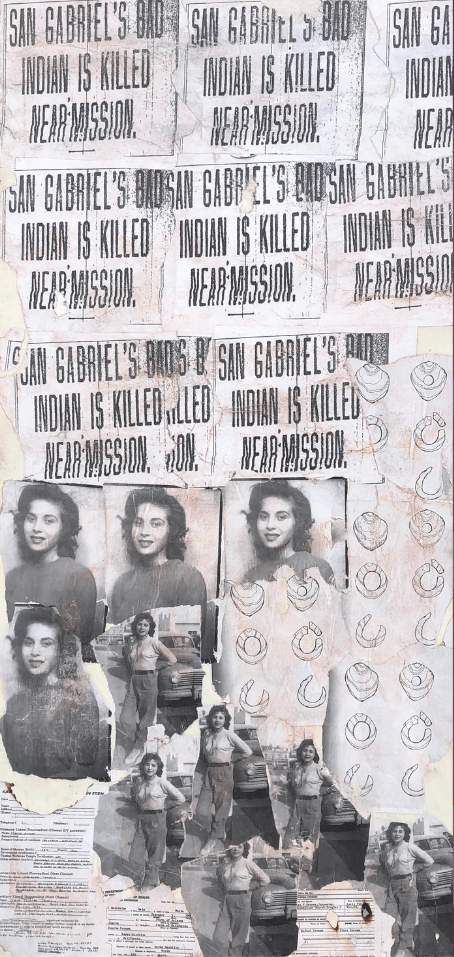
Untitled. River Tikwi Garza (Tongva/Chicano), 2016
(Courtesy of the artist)
In this mixed-media piece, exhibited here for the first time, Garza combines family photos of his grandmother with a 1905 article from the Los Angeles Examiner describing the death of Garza's ancestor, Aciano Rojas, after a fight with another man. Garza says he included the news clipping "to draw attention to the historical devaluation of Indigenous life here in Los Angeles." Juxtaposing his grandmother with the tragic headline highlights the beauty and endurance of indigenous life in the face of institutional, racial violence.
Carleton Watkins (1829-1916)
Legendary photographer of the Western US
Notice the detail in these photographs, and how big the scenes are. Before the iPhone it was not so easy to take pictures like those you see here. In the 1880s, Carleton Watkins needed a whole team of donkeys to carry around his equipment!
Watkins is best known for his mammoth-plate images of the Yosemite Valley and California landscapes. "Mammoth plates" are big, heavy glass slides (around 18 by 22 inches). Watkins' custom-built camera, glass plates, and chemicals weighed almost as much as a car! His tools were cumbersome, but they allowed Watkins to capture vast landscapes that were also incredibly detailed.
If photographs were as difficult to take today as they were for Watkins, what do you think people would take pictures of, and why would they do it? View a four minute video from the San Francisco Museum of Modern Art about Carleton Watkins' extraordinary career here https://www.youtube.com/watch?v=MkR7y-fZP8k
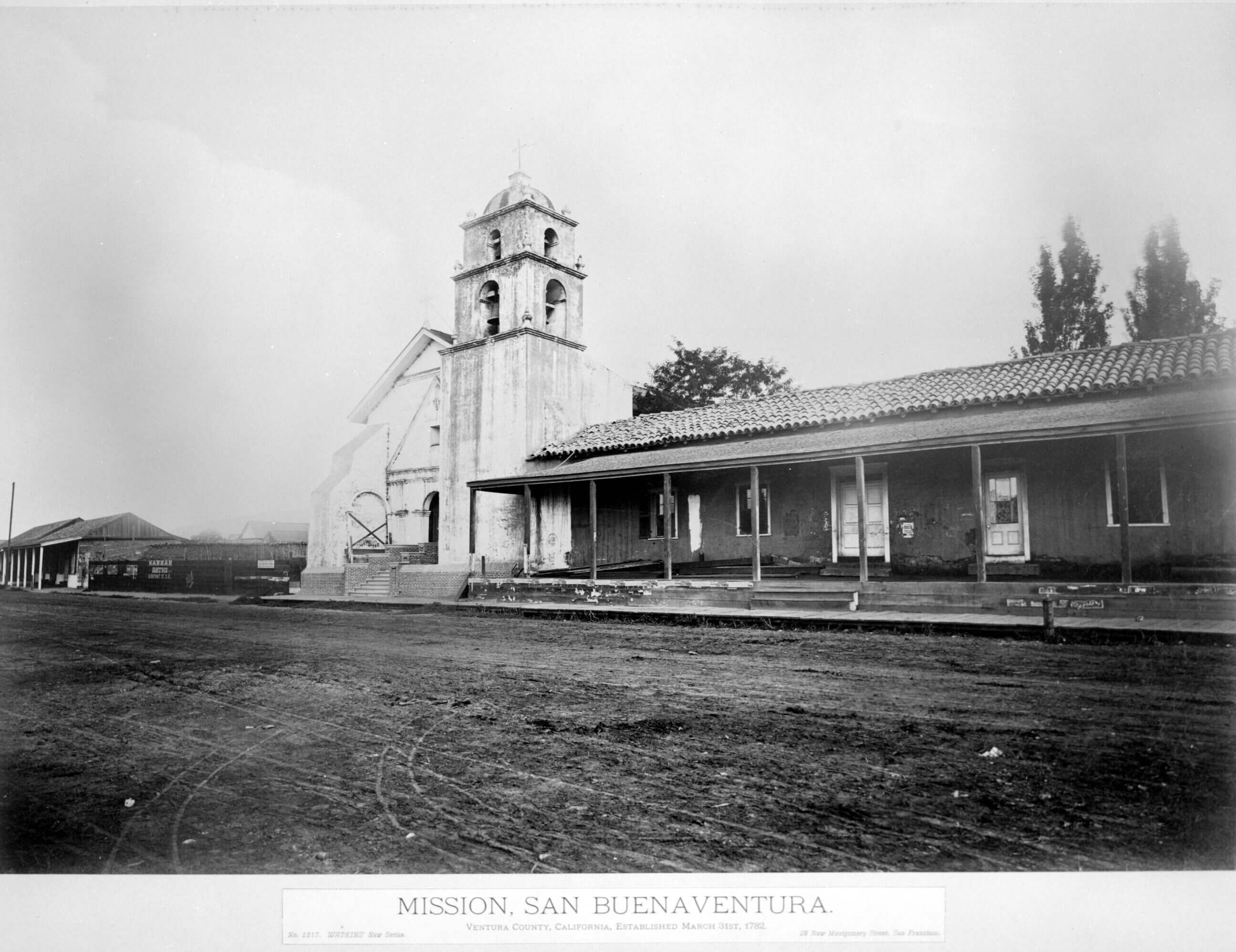
Mission San Buenaventura no. 1217. Carleton Watkins, ca. 18826
(Carleton Watkins Collection of Photographs, UCLA Library Special Collections, Charles E. Young Research Library)
"Composition" refers to how things are arranged in a a work of art. Here, Watkins plays with "pyramidal composition," a technique of classical painting thought to convey harmony and balance. How many triangles can you find in this picture?
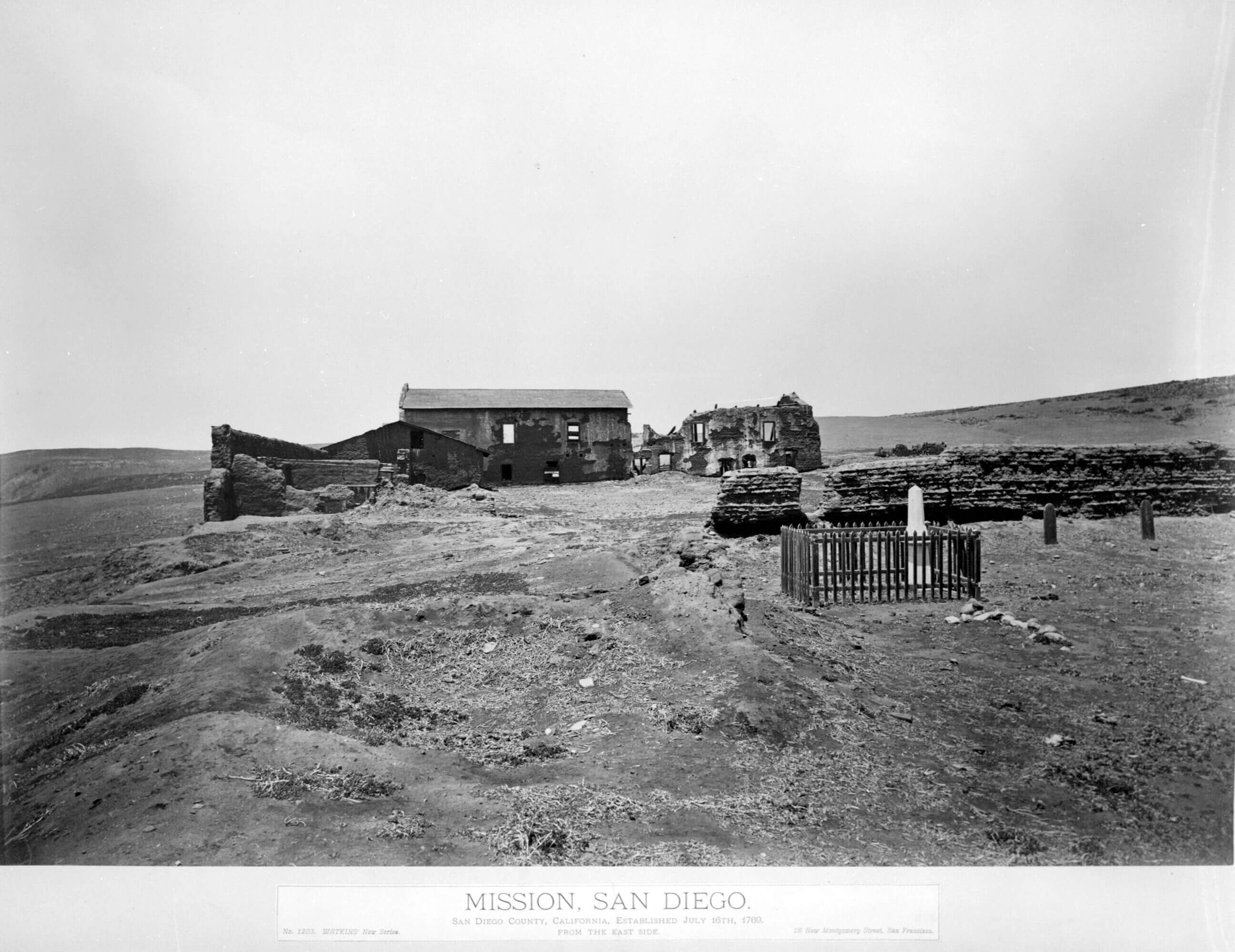
Mission San Diego no. 1203. Carleton Watkins, ca. 1882
(Carleton Watkins Collection of Photographs, UCLA Library Special Collections, Charles E. Young Research Library)
In photography, the "rule of thirds" imagines an image divided into a grid nine equal parts and says that important parts of the picture should be placed at the intersections of the grid lines. With that in mind, what do you think Watkins wants us to pay attention to in this image?
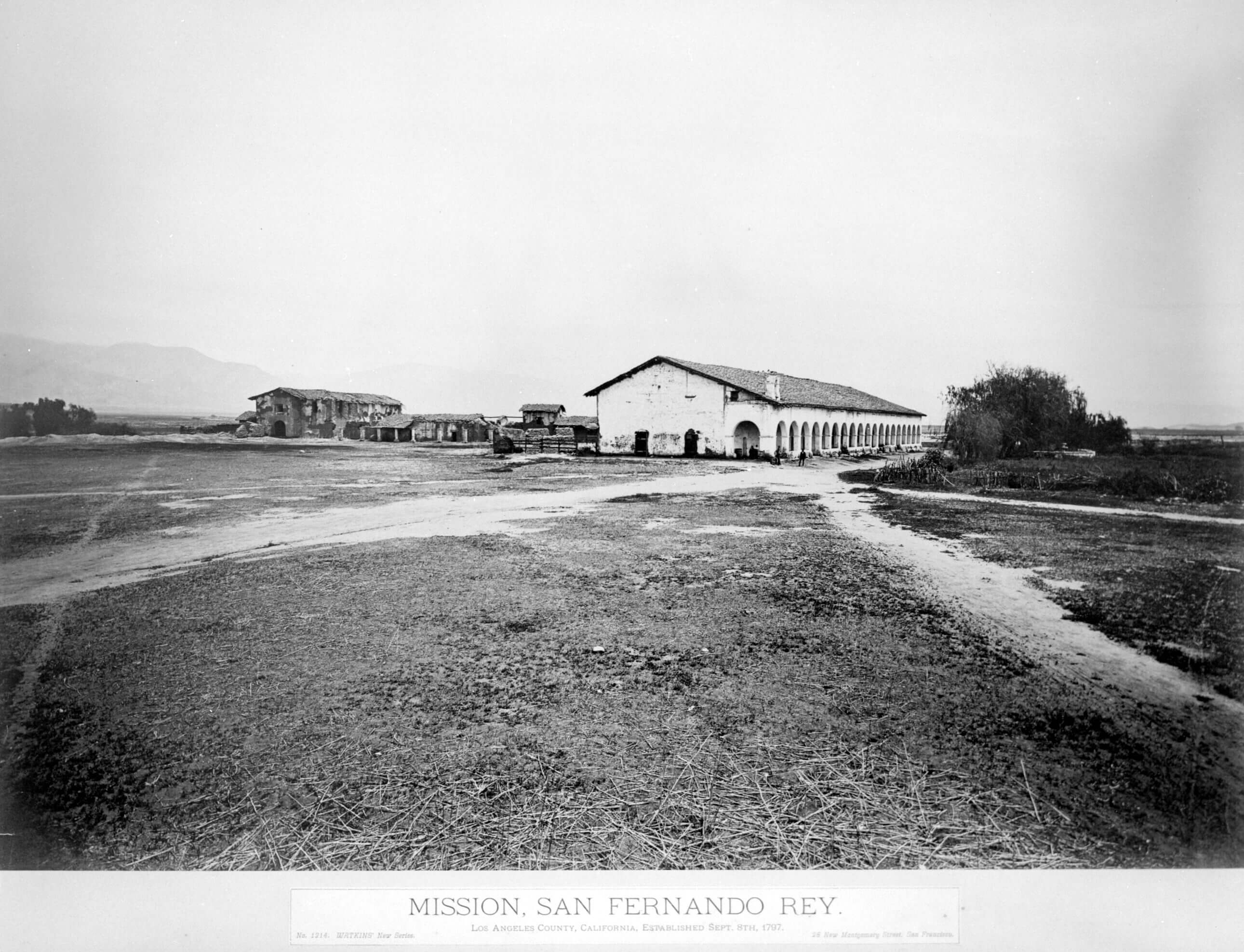
Mission San Fernando Rey no. 1214. Carleton Watkins, ca. 1882
(Carleton Watkins Collection of Photographs, UCLA Library Special Collections, Charles E. Young Research Library)
A "vanishing point" is the place in an image where two parallel lines appear to come together. Artists use this strategy to create a sense of distance and to draw our attention. What are we meant to be looking at in this photo, and why might Watkins want it to seem so far away from the viewer?
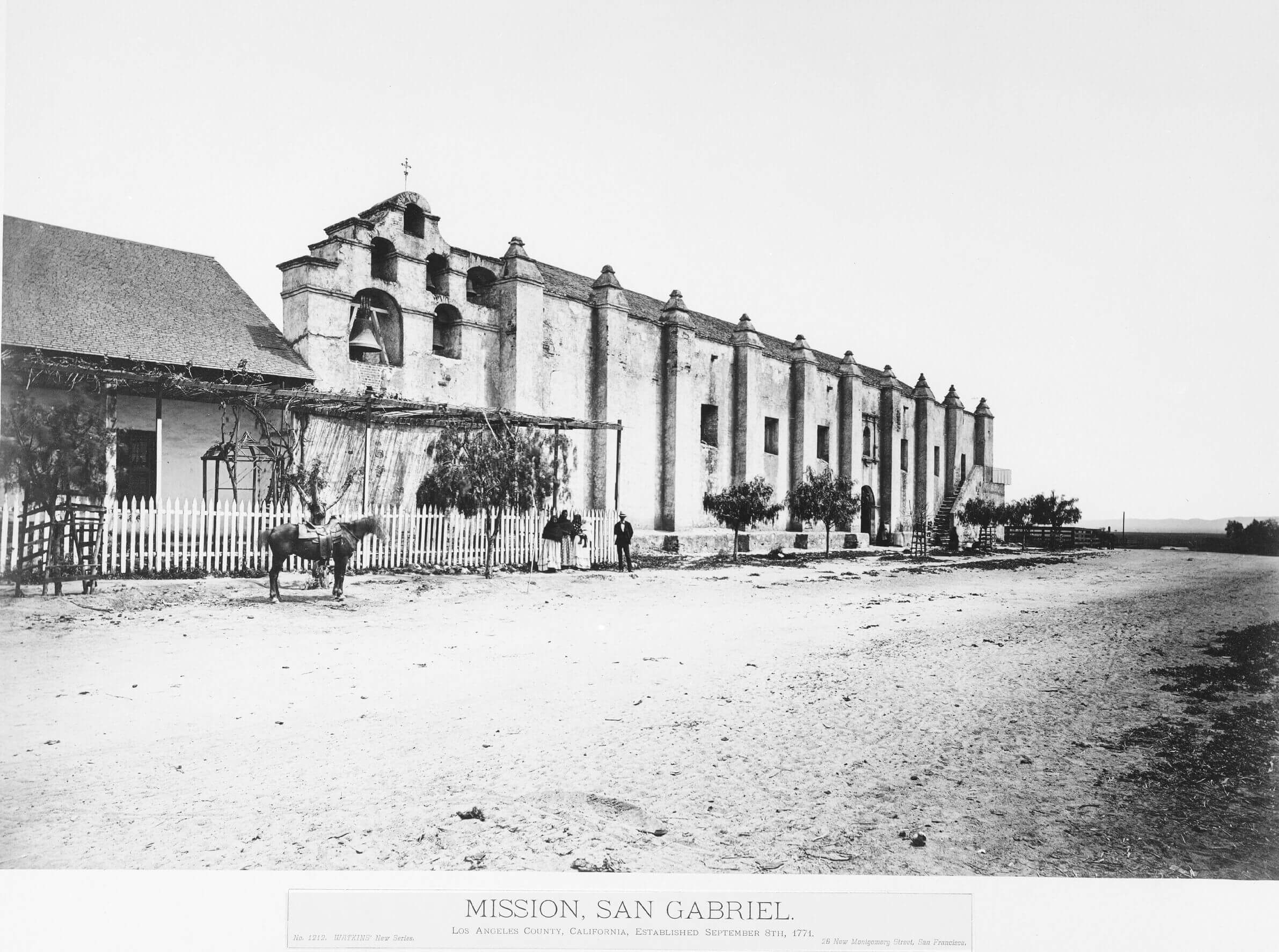
Mission San Gabriel no. 1212. Carleton Watkins, ca. 1882
(Carleton Watkins Collection of Photographs, UCLA Library Special Collections, Charles E. Young Research Library)
What do you notice first in this photo? What else do you see when you look for pyramidal composition and vanishing points, or apply the rule of thirds?
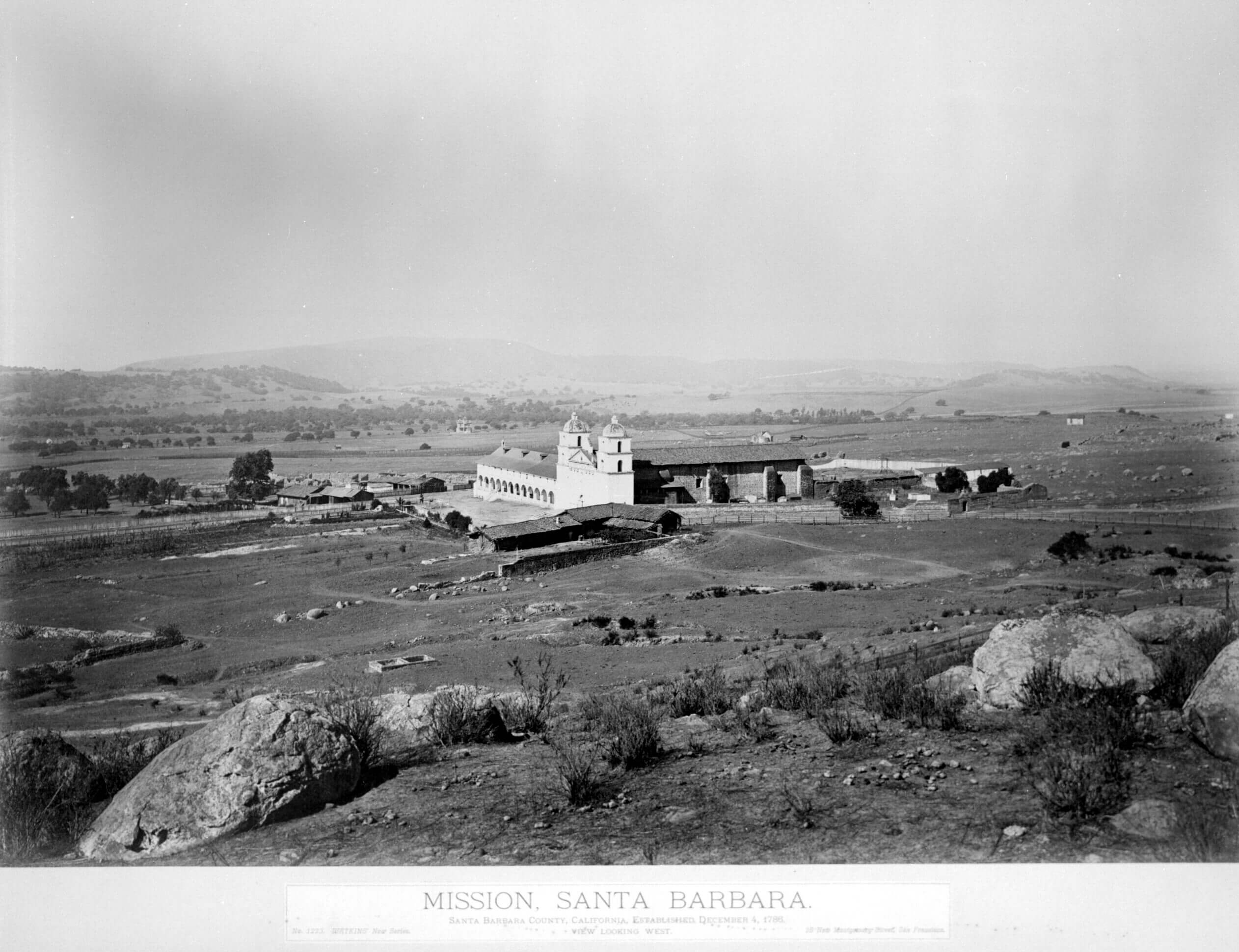
Mission Santa Barbara no. 1223. Carleton Watkins, ca. 1882
(Carleton Watkins Collection of Photographs, UCLA Library Special Collections, Charles E. Young Research Library)
Unlike the other photos you see here, this mission is right in the center of the image. Why do you think Watkins did this? What else might he be drawing the viewer's attention to?